


The Postdoctorate consists of research and/or technological innovation activities conducted by a PhD holder who is not a permanent staff member of UEL. The fellowship is supervised by a tenured faculty member of the university or a Senior Professor/Researcher affiliated with a UEL Stricto Sensu Graduate Program or a CNPq-registered Research Group certified by UEL.
The program aims to:
✔ Consolidate, update, deepen, and expand scientific and technological knowledge
✔ Potentially redirect the fellow’s research focus
Mais informações
Current Postdoctorates
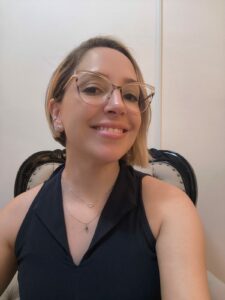
Profª. Dra. Débora Jurado Ramos
PhD in Geography – Graduate Program in Geography, State University of Londrina (PPGEO/UEL)
Email: deborajurado@gmail.com
Lattes: http://lattes.cnpq.br/5613552590791439
Research: From a Geography of Sounds to a Geography of Hands: Phenomenology and Sensitivity in Recognizing Bilingual Teachers’ Skills
Supervisor: Prof.ª Dr.ª Jeani Delgado Paschoal Moura
Abstract:
This research investigates the competencies of bilingual (Libras-Portuguese) teachers through a “geography of hands,” contrasting with the traditional audist perspective (“geography of sounds”). Grounded in phenomenology and critiques of hearing colonialism (Skliar, 2003), it analyzes how integrating Libras, embodiment, and Deaf pedagogy (Lopes & Quadros, 2017) can build decolonial educational practices. The study highlights four formative axes: Geographic understanding of the classroom as a symbolic space (Farias, 2023); Libras fluency as a political act; Anti-assimilationist visual-tactile methodologies; Engagement with Deaf history and culture (Steins, 1994; Santana, 2021). The “geography of hands” reframes gestures and movements as resistance to auditory colonialism, transforming teachers into architects of educational spaces that value difference. Using frameworks like Larrosa (2002), it shows that bilingual education anchored in Deaf experience transcends content transmission, becoming a political act of cultural affirmation.
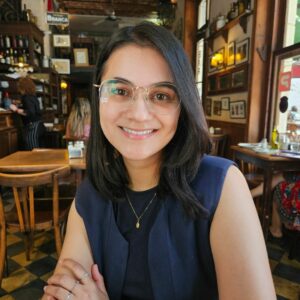
Profª. Dra. Danieli Barbosa de Araujo
PhD in Geography – PPGEO/UEL
Email: danieli.araujo@uel.br
Lattes: https://lattes.cnpq.br/4225431099248274
Research: Interconnections Between Education, Risk Geography, and Geopoetics in Building Potential Resilience
Supervisor: Prof.ª Dr.ª Jeani Delgado Paschoal Moura
Abstract:
We live in an era marked by challenges that intertwine in a complex network of risks, ranging from natural threats to dangers generated by human action. These elements contribute to the configuration of what is currently recognized as a “risk society” (Beck, 1992). In this context, this project seeks to develop a proposal for “Risk Education” anchored in the intersection between Geopoetics and Risk Geography, two lines of study that, when integrated, can contribute to the understanding, characterization, and assessment of risks, with a focus on local-scale studies. The study proposes participatory research, emphasizing awareness-raising and risk mapping. The methodological approach includes a literature review for theoretical foundation, participant mobilization, workshops to explore risk experiences and perceptions, and the application of the “personal cartography” perspective (De Paula, 2012) and “Geopoetic Navigation Logs” (Bouvet, 2012) to create maps and representations based on participants’ experiences. The research will involve geography teachers in training, faculty, and students from the State Education Network of Londrina, Paraná, Brazil. The study aims to strengthen risk awareness, promote resilience, and expand societal participation in risk management, contributing to the construction of a culture of safety and potential resilience.
Postdoctoral Alumni
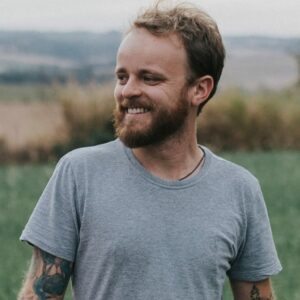
Prof. Dr. Caio Cezar Cunha
PhD in Geography – PPGEO/UEL
E-mail: caiocezar.cunha@uel.br
Lattes: http://lattes.cnpq.br/6067197662297453
Research: Social Cartography and Affective Maps as Tools for Social Public Policy Management
Supervisor: Prof.ª Dr.ª Ideni Terezinha Antonello
Abstract: To understand the territorial logic of populations served by the Social Assistance Policy of Londrina through surveys based on qualitative methodologies of Social Cartography aligned with Socio-environmental Psychology. Our objective is to spatially visualize people’s expressions of esteem for their living places. These approaches allow us to classify empowering or disempowering esteem in a way that enables linking these feelings to quality of life and people’s willingness to act in situations of personal precarity and risk. Our results aim to provide alternatives in understanding social demands to complement the tools that support the management of these territories.
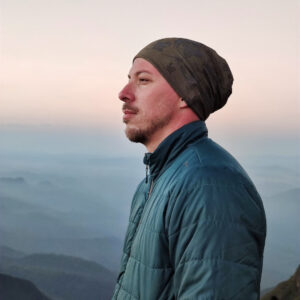
Prof. Dr. Paulo Henrique Marques de Castro
PhD in Geography from the Graduate Program in Geography at the State University of Londrina (PPGEO/UEL)
Associate Professor at the State University of Northern Paraná (UENP), Cornélio Procópio Campus (PR)
Email: paulocastro@uenp.edu.br
Lattes: http://lattes.cnpq.br/0900608828526163
Supervisor: Prof.ª Dr.ª Adriana Castreghini de Freitas Pereira
Abstract: In the current context of the expansion of geotechnologies, Unmanned Aerial Vehicles (UAVs), such as drones, have been widely used for various domains, ranging from military to civilian applications. For the analysis of certain phenomena, particularly in small areas, aerial photographs have become attractive due to lower operational costs. The research aims to investigate the potential of aerial photographs obtained by drones for improving methodologies aimed at generating indicators of socio-environmental risks and vulnerabilities, based on the investigation and comparison of areas in the context of northern Paraná State. The study will base the analysis of potentialities on two perspectives: i) technical, where, through image processing, it is possible to extract geographic information; ii) photographic language, which operates simultaneously in the field of the intelligible and the sensible, providing a range of information in various fields of knowledge, which the researcher can use to reconstruct and interpret a given social reality. As results, the improvement of existing scientific methodologies for socio-environmental risk and vulnerability analysis is expected, based on the production of a methodological strategy that incorporates the use of modern geotechnologies for the integrated analysis of physical and social environmental elements.
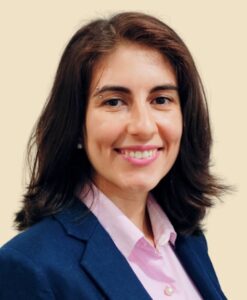
Prof.ª Dr.ª Graziele Muniz Miranda Hoffart
PhD in Geography from the Graduate Program in Geography at the State University of São Paulo (UNESP)
Email: gmunizmiranda@gmail.com
Lattes: http://lattes.cnpq.br/9494596851160065
Supervisor: Prof.ª Dr.ª Ideni Terezinha Antonello
Research: Proposal of Environmental Justice Indicators as a Tool for the Socio-assistance Surveillance Sector in the Municipality of Betim-MG
Abstract: Historically, social policies in Brazil have focused on combating poverty, deprivation, and strengthening affective bonds, without questioning the socio-environmental injustices that disproportionately affect users of Social Assistance Policy. The research investigated the main challenges and suggested proposals for the implementation of socio-environmental public policies in the municipality of Betim-MG. In addition to bibliographic research, thematic maps were prepared, and semi-structured interviews were conducted with workers from the Municipal Secretariat of Social Assistance of Betim-MG.
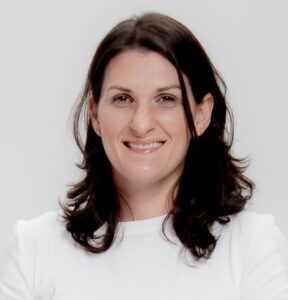
Prof.ª Dr.ª Nathália Prado Rosolém
PhD in Sciences from the Graduate Program in Human Geography at the University of São Paulo (USP)
Email: nathaliarosolem@hotmail.com
Lattes: http://lattes.cnpq.br/9461339651464405
Supervisor: Prof.ª Dr.ª Adriana Castreghini de Freitas Pereira
Research: Methodological Proposal by André Journaux (1979) Applied to the Environmental Dynamics of the Urban Area of Londrina – PR
Abstract: Based on the cartographic methodology developed by French geographer André Journaux (1979)—which proposes a general legend adaptable to different geographical spaces—this research aims to map environmental data and its dynamics in the urban area of Londrina, Paraná. For this purpose, an adaptation of Journaux’s proposed legend was used, previously adjusted to the municipal context by the researcher herself and published in the Revista Confins in 2009. The study focuses on creating a collection of analytical and correlation (system) maps, produced within the Geographic Information System (GIS) environment.
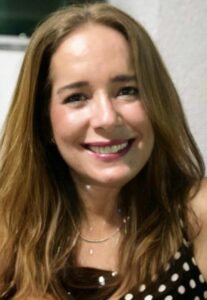
Prof.ª Dr.ª Jussara Fraga Portugal
PhD from the Graduate Program in Education and Contemporaneity at the State University of Bahia – UNEB.
Professor at the State University of Bahia – UNEB
Email: jportugal@uneb.br
Lattes: http://lattes.cnpq.br/6864330564882128
Supervisor: Prof.ª Dr.ª Eloiza Cristiane Torres
Research: Trajectories of Learning in Geography Teaching: Narrating, Training, and Beginning
Abstract: The research, linked to the postdoctoral fellowship under the supervision of Prof. Dr. Eloiza Cristiane Torres, conducted within the Graduate Program in Geography at the State University of Londrina (UEL), was based on the subproject Teacher Training and School Geography: From Spatial Practices and Knowledge to the Construction of Geographic Knowledge, whose actions were developed at the State University of Bahia, Campus XI, and in six basic education schools in three municipalities – Conceição do Coité, Serrinha, and Teofilândia – in the Sisal Identity Territory. This investigation, through the analysis and interpretation of narratives from 15 Geography teachers in initial training, scholarship holders for teaching initiation, aimed to understand how these teachers conceive learning in/about teaching and what meanings are attributed to training and teaching Geography (teaching experiences) resulting from the actions that composed the pedagogical proposal of the subproject Teacher Training and School Geography: From Spatial Practices and Knowledge to the Construction of Geographic Knowledge, linked to the Institutional Program for Teaching Initiation Scholarships (Pibid). This is an investigation-training with a qualitative approach, anchored in the principles of the (auto)biographical method, whose sources – memoir, training diary, and narrative interview – enabled the apprehension of the investigated object. The narratives revealed significant episodes in the life-schooling-training trajectories and highlighted the contributions of the formative situations experienced during the actions of the aforementioned subproject and their implications in the construction of teacher identity. This research was funded by the Coordination for the Improvement of Higher Education Personnel (Capes), through the National Postdoctoral Program (PNPD).
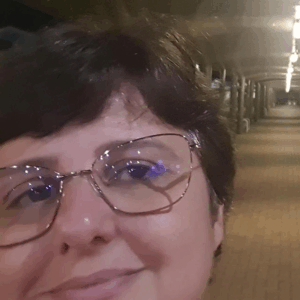
Prof.ª Dr.ª Léia Aparecida Veiga
Doctor in Geography from the State University of Maringá (UEM), Master in Geography, Environment, and Development from the State University of Londrina (UEL).
Professor in the Geography Program at the Federal University for Latin American Integration – UNILA.
Period: 2017 to 2018
Email: leia.veiga@uel.br
Lattes: http://lattes.cnpq.br/9940086723504263
Supervisor: Prof.ª Dr.ª Eloiza Cristiane Torres
Research Topic: Environmental Education
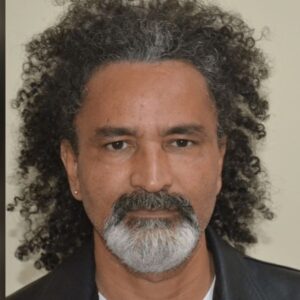
Prof. Dr. Edvaldo Carlos de Lima
Doctor in Geography from UFPE – Federal University of Pernambuco – Recife Campus/PE
Professor at the State University of Paraíba – UEPB
Period: 2017 to 2018
Email: edvaldo.edvlima@gmail.com
Lattes: http://lattes.cnpq.br/9077154635715473
Supervisor: Prof.ª Dr.ª Eliane Tomiasi Paulino
Research Topic: Rural Education
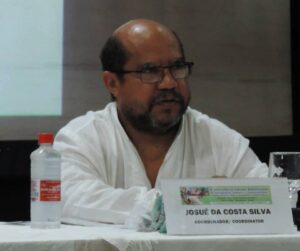
Prof. Dr. Josué da Costa Silva
Doctor in Geography (Human Geography) from the University of São Paulo (2000)
Full Professor in the Department of Geography at the Federal University of Rondônia – UNIR
Period: 2016
Email: jcosta1709@gmail.com
Lattes: http://lattes.cnpq.br/8909795919185303
Supervisor: Prof. Dr. Nilson Cesar Fraga